
BookingSuite: A Lesson in Direct Revenue Strategy

direct revenue strategy

Throughout my career in revenue optimization for the hospitality and travel industry, I have always stressed the importance of owning your digital assets. This means having control of your domain, your marketing campaign’s analytics and history, and especially your website. As a strong supporter of open source technology, I have stepped in every time a marketing vendor (“expert”) started trashing new and innovative options for hotels. Of course, vendors will always favor their outdated proprietary systems over new technology. They have made a huge investment and have to keep selling. But being tied to old technology is never going to give your hotel an edge in the online marketplace.

WordPress is a perfect example. As a flexible, secure, and user-friendly website platform, it has been displacing proprietary content management systems worldwide. Threatened, some hotel marketing agencies starting publishing propaganda about WordPress; they said it was “unsafe” and did not include essential “marketing features.” In response, I have steadfastly encouraged hotels to embrace open source and steer clear of fear-mongering by agencies trying to push their agendas. Of course the agencies want you hooked on their website platforms. It provides them with the security of you not leaving them. Know that when you do leave, you will be left with nothing but a zip file containing the remains of your most profitable channel and a “we are sad to see you leave” email. Good luck!

Case in Point: BookingSuite

In 2014, I wrote a detailed article on Priceline’s Acquisition of Buuteeq, in which I again outlined the importance of owning your digital assets. Buuteeq was run by smart people who tapped into the reluctance of hotels to invest in their own direct revenue strategy. They offered to relieve hotels of the headache of owning and maintaining their digital assets, starting at just $99/month! They did a great job of marketing themselves and were able to successfully scale their own business by offering websites and marketing packages to hotels for a low monthly fee. At a crucial time when direct marketing investment was already a massive challenge for hotels, this approach was not doing the hotel industry any favors.

After the Priceline acquisition, I tried to make the strongest possible case for not renting your website and your marketing strategy from the largest online travel agency in the world. Priceline Inc. has its own agenda for growth. If you were to look at their stock performance and revenue breakdown, you would see that they do not make money building websites or running your marketing campaigns. They make money when people use their suite of OTA websites to book a room. Surprise! They prioritize their own direct revenue channel over yours.

Unfortunately, the illusory free lunch is too tempting for a lot of industry folks. BookingSuite (Buuteeq’s new identity under Booking.com) did more than just retain Buuteeq’s hundreds of hotel and B&B clients. They heavily leveraged the reluctance of hotels to spend time and money on marketing and signed up more hotels than ever. This seems to be a fatal flaw for hotels. They have made a habit of outsourcing 100% of their marketing to the vendor with the lowest bid. Then they get to check the box labeled “direct revenue strategy.” Death by checklist? Check.

Folks, We Have a Hard Stop

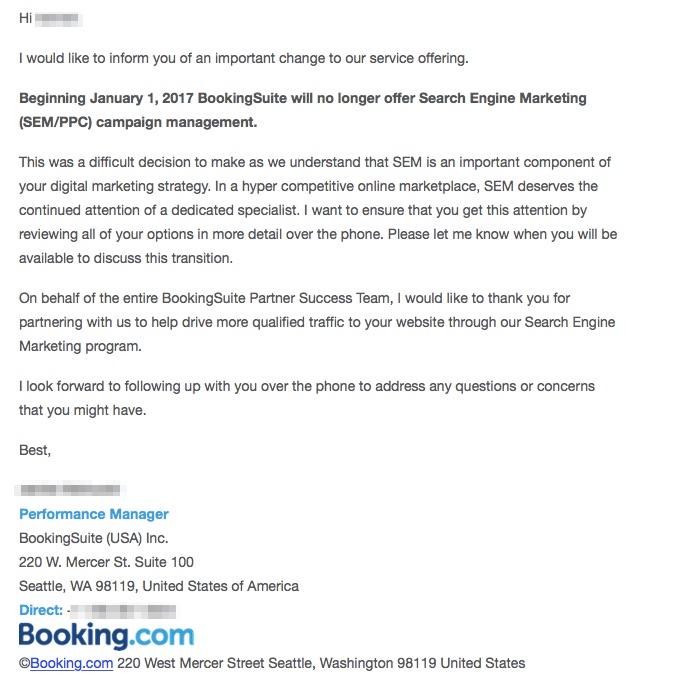
Earlier this week, BookingSuite announced that it will no longer be offering Search Engine Marketing services to hotels using their website platform. Below is the official email that was sent out to hotels using their system:
bookingsuite

They could not have summarized it better:

SEM is an important component of your digital marketing strategy.

You know what else is an important component of your digital marketing strategy? Your website. The thing that so many hotels are currently renting from BookingSuite. If they can drop SEM …how much sleep they would lose over the few dollars you pay them every month to rent a website? That $99 to $999/month website does not sound like such a hot deal now, does it?

Here is some Shakespeare for added effect:

“As flies to wanton boys are we to the gods. They kill us for their sport.”

― William Shakespeare, King Lear

Your website, booking engine, digital marketing efforts, and revenue management strategy are the pillars of your direct revenue. Viewing them as cost centers instead of investments in your future is the root problem underlying disadvantageous marketing decisions for hotels of all sizes. This cost vs investment approach (looking at departmental budgets instead of overall growth and revenue) is causing hotels to act against their own self-interest; it makes you pick the wrong vendors for wrong reasons.

Not to get all Nostradamus on you, but I would like to quote myself from all the way back in 2014:

“Ownership of your digital assets is more important than ever before in the history of the lodging business. Who provides your technology and in what format really matters. In this case, if your hotel is using a website made by Buuteeq, your site is now essentially a subsidiary of one of the biggest OTAs in the world.”

This Is the Checklist You Need

The fact remains that the majority of hotels and inns worldwide are renting their digital assets; and this is hurting their long-term direct revenue potential. When you make all your marketing decisions on the basis of lowest possible cost, your long-term profitability will suffer.

If you’re ready to take control, here’s a five-step checklist to get you back on track.

  1. Website. Pick any designer/website vendor in the world… but build and power your website using WordPress as your CMS. It is always the right time to start running and managing your most profitable digital channel using open source technology.
  2. Search Engine Optimization. Google is all about website speed, health, usability, and useful content. There are no secret algorithms that any agency has in place to tackle this. You can read in detail here how search engine optimization has changed for the hotel and travel industry over the years. Staying with a vendor because they are good at SEO and “keyword rankings” is like investing in the stock market using a psychic as your portfolio advisor.
  3. Pay Per Click. Here is some detail on why PPC is one of your most powerful marketing tools. Pick any vendor you like as long as you use your own credit card to pay Google directly and own your AdWords account. Yes, you should own your AdWords campaign so that you maintain control of your history and retain the quality score built over years of spending and testing. That way, when your vendor wants to peace out on you (example: what BookingSuite is doing now), it won’t be a big deal. You will have to find a new vendor; but you will not have to start from scratch again.
  4. Social Media. Make sure the ownership of all of your social media accounts stays with you. Use your email address, and not a vendor’s. This includes Facebook and all other social media marketing campaigns that you are currently running.
  5. Analytics. Stick with Google Analytics. Here is a detailed article on staying away from expensive solutions designed with agencies in mind. When working with Google Analytics, always set it up with a Gmail address that you own. You might have several vendors working on your account with access to the same data. But they shouldn’t control the account. Avoid the headache hotels experience every day when the vendor who owns their analytics account decides to walk away, taking years of website data with them.

Here is a detailed guide on managing all your digital assets. Successful hotel and travel marketing departments own and continually build on their marketing and digital assets. Just like you would not build a hotel on land that you do not own (or lease for a long time), your online assets should not be built in someone else’s proprietary digital environment. Of course, you will always need someone to help you maintain your hotel/home. But you don’t have to give someone the deed to the house in exchange for making sure the plumbing is working. *mic drop*

Conclusion

People I have worked with over the years know that I do not believe in declaring “wars”; I believe in making revenue. The hyperbole in the marketplace around the “war on OTAs” is impractical and annoying. Using this article to launch a tirade against BookingSuite is a complete waste of time. You cannot blame others for your poor decisions. Also, please remember that Priceline Inc. and Expedia Inc. are not going anywhere anytime soon. So, buck up, Champ.

My goal here is to highlight that now is (still) the perfect time to invest in owning and maintaining your digital assets and marketing campaigns. Marketing agencies and vendors will eventually get acquired or lose interest. Nobody can control or predict when that will happen to your marketing agency. I could not have predicted the exact date when Buuteeq (the helpful agency who wanted to take all your work and worries away at a super low price) would sell out to the world’s largest OTA…. or the date when they would later shut down the SEM services that were not making them enough money. What I can do and always will do is to recommend that you own and invest in your own digital assets and marketing. Remember: your profitability needs to outlast your current marketing agency. Stay woke.

Marriott’s Acquisition of Starwood: Winners and Losers

Marriott’s acquisition of Starwood is great news for investors, but unfortunately not for Starwood hotel guests and employees. The quote that sums up the reasoning behind this deal came from Starwood Chairman Bruce Duncan.

“We are committed to what is best for shareholders.”

Notice that employees and guests are not mentioned. This is because they are not the focus of the consolidation. Industry consolidation is aimed at increasing investors’ profits or killing a competitor in the industry. With this deal, Marriott is hitting both those key points. When a deal like this is made, the numbers have been run and re-run hundreds of times. Everything must look good on paper, first and foremost. Banks and investors are going to be the clear winners in this deal.

However, I’d like to talk about the important players in this deal that are not likely to fare too well: the guests and the employees.

Guests (The Case of the Diminishing Rewards)

The massive march toward total devaluation of loyalty points continues onward. Every major hotel chain has devalued its rewards program in the past five years. Hilton, Marriott, Starwood and Carlson issued major devaluations in their loyalty points in 2013 and again in 2015. Historically, mergers have almost always resulted in devaluation of loyalty programs and inferior service. Anyone who thinks bigger is better when it comes to personal attention has obviously never called his cable company.

In 2013, Marriott created a new (read higher) category of hotels: the super “category 9” hotels, where it takes 45,000 points to stay for one night! They also raised the points requirement per night on 40% of their portfolio, which in their case was an increase of around 5000+ points to book a room. In March 2015, Marriott moved approximately 25% of their hotels into a higher bracket; that means you now need more points per night to get a room in the same hotel.

Starwood has been known to have the best elite program in the game. Even so, earlier this year 20% of their hotels did the category shuffle. The difference is that, in their case, half of the hotels in this 20% segment moved up a category and the other half moved down. Much less drastic than Marriott.

With Marriott taking over and a loyalty program merger inevitable in the near future, the overall value proposition is going to go down. It might be good for low- to mid-level SPG status holders, but the super elites will take a hit. Even the credit card offers from Starwood have always been out of Marriott’s league. There is no other way this is going to play out: the existing Starwood elite SPG program will take a hit.

I was disturbed by the whiny and entitled responses to the merger by the “elites” in this NY Times article. But the fact is thing are going to get worse for them and they know it.

Employees

History and common sense both tell us that consolidation is hardly ever good news for employees. This merger is no different than most in that respect.

Starwood made some mistakes over the years by spreading itself too thin specially that their gable in Asia, Europe and the Middle East didn’t really pan out. If you remember, they took a lot of pride in “moving” their corporate offices to international hubs for 30 days (China, Dubai and India for 30 days). Because, what motivates a team more than jet lag…right? This was nothing more than a gimmick, like that time in 2006 when Starwood Hotels opened in Second Life, which was supposed to be the next big thing. You really cannot be going international when all your core marketing and strategy is centralized in Stamford, Connecticut. 

Anyway, with this expansion came international teams. So guess what is going to happen in Singapore and Hong Kong and New Delhi, where both hotel chains have regional presence? Will they need two Sales Directors, Revenue Managers, or Operations Directors sitting in two offices in the same city? What about in the US where Marriott already has a massive corporate team? Short answer: No.

Marriott has made a name for itself with its efficiency. Kudos for that. But this also means that they are not going to be supporting multiple teams of people to do the same job. This is particularly relevant to employees in senior and cluster management and operations positions.

The market right now is flooded with Starwood resumes. This is especially true in international markets. Since I am very fortunate to have friends working globally for large hotel chains, I know for a fact that there is some panic in the job market.

Most guests will be fine and will deal with the changes in the loyalty program and dwindling levels of personal service over time. But the human cost in terms of disrupted careers and lost opportunities is harder to absorb.

Conclusion

It’s not all doom and gloom. This merger presents a huge opportunity for independent and ultra-luxury hotels. It’s the perfect time to outshine the rapidly diminishing hotel loyalty programs that the behemoth hotel brands are trimming and slashing, by offering a unique experience that includes highly personalized service. Another group that should be celebrating this consolidation, aside from the bankers, is Airbnb and the other apartment/home rental players. This is just what they wanted for Christmas, even if they didn’t know it. More business travelers will be looking to go rogue when faced with diminishing loyalty points, and therefore diminishing loyalty.

Do You View Hotel Marketing as a Cost or an Investment?

I am often asked, “What is the most important factor in a good hotel marketing strategy?” One of the top factors (that no one likes to talk about) is how a hotel’s owners and management view their marketing budget.

Those who treat hotel marketing as an investment will be able to maximize their online revenue potential. They will keep spending investing online, as that is where their audience lives, breathes, researches and books their trips.

Those who view it as a cost will treat it like any other cost; they strive to keep costs down. This group is the one that gives away revenue and market share to the OTAs and their competitors.

Here is a detailed review of the two approaches.

Approach #1: Treating Online Marketing as a Cost

If you are treating online marketing as an expense in your budget that needs to be kept under control, you are very likely on the losing side of the marketing battle. When you apply the cost reduction approach, it puts tremendous pressure on your already limited budget to perform quickly, while limiting your ability to test and optimize your marketing efforts.

No testing or expansion of marketing => Stagnation and decay in your online presence and decline in direct revenue

(Let’s be clear: Your OTA-contributed revenue continues to increase. That’s because they never hold back, while you agonize over every cent you spend.)

Cutting costs might work when it comes to laundry, lotions and soaps that you use in your hotel, but it can hurt you badly when applied to digital marketing.

Here are some specifics on why your revenue will suffer in the long term:

Online travel is huge and getting bigger.

Yes, online travel is like the Beatles in the 60s or yoga pants today. In numbers, it’s going to be hitting $830 billion in 2017. The pace of growth in the Asia Pacific region is enough to make you dizzy. When it comes time for you to sit down and plan your hotel marketing budget for the year ahead, you have to know that online is where all the action is happening. Deciding to sit this one out because you are keeping marketing “expenses” in check is a recipe for disaster that has cost the hotel industry billions in direct revenue.

ROI is a deathtrap.

I have written in detail about this and have personally seen this tragic scenario unfurl like a bad dream. It’s like my own personal Groundhog Day. “ROI” is notoriously hard to track in this multi-device, constantly connected world. For many hotels, especially the ones struggling to meet their overall objectives, any unquantifiable expense can seem like the perfect candidate for a budget cut. So, hotels keep doing online cost-cutting and “vendor hopping“ because they are “not seeing the ROI” (cringe). Agencies who try to win your business based on 5700% ROI promises are always a bad choice. You’ll pay them a small fee, helping you balance this year’s budget; but when the contract is over, you’ll just limp into the arms of the next vendor. The big picture: your direct revenue continually declines, your brand suffers, and you have to start all over again every year. Meanwhile, your online competitors (particularly the OTAs) keep building their long-term strategy and converting the traffic that should be yours.

Google is still King, and it wants more money.

Google is still the king of travel marketing, and looks like it will be sitting on the throne for some time. The beauty of Google is that it has all the phases of the booking cycle covered: Discovery, Research, Rate Shopping, Getting to and From a Destination… all the way to the drive back to your home after the vacation. Google has it all. The SEO Bubble burst in 2013, so now you have a clear choice: pay to play.

Google will be your best friend as long as you are willing to pay for it. Hotel pay per click is one of the cornerstones for generating direct revenue. You want to reduce your marketing costs? Sure, go ahead. Google will be happy to sell its ads to willing and highly motivated online travel agents who make millions billions bidding on your name, location and destination. It’s great for them when you are not there to compete, especially on your brand name searches.

Cliché Alert: It takes money to make money.

It might seem easy to cut back on marketing expenses to save money, but you have to consider what else you’re losing. Example: Reducing your Google PPC budget from $10,000 to $3000 a month saves you $7000 a month. But at the same time, your ads don’t run, your revenue starts to decline, and your leads have been cut way back. No new leads and no new conversions are a lethal hit on your profitability and direct revenue. It used to take months, but now you will feel the revenue hit in a matter of weeks. That sinking feeling? Yes, it’s your revenue tanking because you stopped spending. Welcome to the reality of doing business in 2014.

Approach #2: Treating Online Marketing as an Investment

This is the winner’s circle. Online marketing really is an investment in your present and in your future. It cannot be thought of as an optional expenditure. Think of it as a paying career and a retirement fund rolled into one. Effective marketing pays your bills in the short term and sets the foundation for the long-term profitability of your hotel. The hotels who are doing it right will exponentially increase their profitability over time.

Here is how it’s done right:

Target the entire travel funnel.

The smartest hotel ownership companies and individual asset owners understand the dynamics of the entire sales funnel. Their investment in hotel marketing is targeted toward prospects in every part of the funnel (research, planning, booking). Efforts include:

  • Investing at the top of the funnel to attract prospective new guests (ie, Boston Vacation, Boston Hotels, Boston Things To Do)
  • Investing at the bottom of the funnel to convert prospects into guests (ie, Your Hotel Name)

Push the limits.

The most dramatic successes that my partners and I have achieved for hotel clients had one thing in common: We were asked to investigate and give them the dollar amount needed for total market domination. Whether they were rebranding, opening a new hotel, revitalizing a faltering asset, or preparing to sell the asset… they knew that the striking results they wanted required proper investment. Instead of racing down to the bottom, the owners were looking to make a lot of money. There was no room for light or smooth jazz online marketing. Done right, with revenue as the supreme goal, we’re talking hard core Spinal Tap style marketing, cranked way up to 11!

(Effective revenue management is also required, but that topic deserves its own blog post.)

Conclusion

Hotels who treat online marketing as a scalable cost are seeing a decline in their direct revenue and losing market share to their competitors and online travel agencies. A cost-based approach hampers your growth today, and prevents you from being able to build your brand online. Vendor-hopping toward low profitability and automated marketing platforms is a sure shot way to lose revenue. Let’s face the facts: Print media is not making a comeback anytime soon. Nor are carrier pigeons going to bring you your future reservations. If not online, where else should you be investing? If revenue is important to you… wake up, and put your money where your revenue is!

Reality Check: 7 Questions for Your Hotel Marketing Agency

Everything digital, including marketing, changes rapidly. Hotels know that online marketing is crucial, yet they take a back seat on innovations. Most of the hotel owners/managers I’ve met have been hesitant to do much more than hire an outside agency to handle all things digital. They lack the time, budget, knowledge or interest to get more involved.

Change is in the air again; online marketing for hotels continues to rapidly evolve. So even if you’re not one of those typical hands-off agency clients, there are some questions you need to ask the people you have hired to generate revenue for your hotel through your most profitable channel: your website.

Here are the 7 questions you need to ask to determine how well your digital revenue is being managed.

1. Who is doing the actual marketing work for my hotel?

This is the #1 question you need to ask. Is there a smart, experienced digital marketer looking at your campaign stats and strategy, or is your work being processed by interns in cubicles, or worse… by an automated system with no human oversight.

The large hotel marketing agencies use a factory style approach, which means that the Account Managers are handling several accounts. Your Account Manager is not conducting market research or studying your campaign stats. She is juggling hundreds of emails, chasing down questions and responses, and coordinating conference calls. Meanwhile, an army of task-oriented mass marketing drones report to her; their job is to execute the exact same “strategy” and tasks for every one of her clients. (Picture the factory floor of T- 800 in Terminator. Scary.)

Other than sounding pretty depressing, why does it matter so much to your bottom line? Because mass production cannot produce personalized strategies, and therefore can’t help you compete in today’s marketplace. Personalization has penetrated digital marketing in all industries. Only a thinking person who is setting up a custom strategy and implementing it for you can help you win.

I can’t lay all the blame for this trend on the agencies. Hotels have demanded lower and lower prices, while giving less and less attention to what the agencies are doing. They practically forced the agencies to compete on price, which requires automation and economies of scale. A classic “be careful what you wish for” situation.

Now it’s time to decide how important your online revenue is to you. If you’re ready to take an interest, start by making sure that you another are not just another cog in the nameless wheel of online hotel marketing. Pay a little more if you have to. But keep going back to question #1 – make sure you know what you’re paying for.

2. Are you using any proprietary technology developed by your agency?

If the answer is yes, this is a huge red flag for your online marketing future. There is no gentler way to put this: proprietary software developed by an agency kills innovation. Anything an agency designs and invests money in developing is always going to be focused on making the life of the agency simpler and more profitable. (See #1 above re: agency survival.) Agency software, such as their own content management system (CMS) or digital marketing system (DMS), is not going to help you be an outlier when it comes to online revenue optimization.

It is no secret that I am a huge supporter of WordPress and Google Analytics. As a hotelier looking to truly make a profit, you should be too! Set your priorities right. Build your own revenue, and not just the profitability of your online marketing agency. This is what your hired them to do…remember?

3. How many clients do you have?

Here is how to translate their answer into the level of attention your hotel marketing campaign will get:

• 10-15 – You have a decent chance of getting to work directly with marketing professionals.
• 15-50 – You have a slight chance of getting some personal attention.
• 50-100 – “Your hotel sounds familiar. Who are you again?”
• 100-500 – You are just an account number. No one knows anything about your actual hotel.
• 500-1000 – “Hello, this is Sam, your 14th new Account Manager. Thanks for continuing to send in your monthly check. We don’t have time to talk to you, so don’t even try calling.”
• >1000 – “Hello Client 98765, we have been acquired by a billion dollar company and we really don’t care what happens to you.”

More clients = more employees = more layers = more automation = more mass produced marketing = lower revenue for your hotel.

4. How many clients do you have in my hotel’s market?

Online marketing has a vast reach worldwide. In order for you to reach your full hotel marketing potential, your geographical location has to be a key factor. If your hotel marketing agency has even 1 or 2 other hotel accounts in the exact same market…guess what? The same team that is servicing your account is also working on your competitor’s websites, promotions, packages, PPC and SEO initiatives. That means that everything that has worked for you (specials, packages, promotions, etc.) is going to be used to benefit your direct competitor as well. This “communal” marketing costs you profitability. There are plenty of fish in the sea, but your hotel marketing catch of the day is going to be shared with every other hotel that your agency is servicing in your location. (Yes, sounds fishy, doesn’t it?)

5. Have you done anything other than hotels?

Working in multiple industries provides great learning experience. Throughout my hotel career, I took on interesting and challenging work from diverse sectors like health care, board games, web hosting, etc. If the people working on your account have never looked beyond the hotel industry (and perhaps never beyond their own agency), then you know that they are not going to bring anything exciting to the table.

Industry experience is great. But it’s disturbing to me that hotels are so much more willing to be a nameless, faceless client with an “established” agency rather then give an industry outsider a chance to help them make more money online.

Choosing not to ever work with someone who has outside experience is going to be your loss entirely. I know hotel marketing sounds really complicated, but in fact it’s not. It’s okay to consider letting a specialist from another industry help you out or bring your fresh ideas. Don’t fall for the “do you speak hotel sector language” trap. The language your agency needs to be fluent in is marketing. Besides, if they “speak your language,” remember that they are recycling the same marketing hype to everyone in your industry.

6. Are you a full-service agency?

If the answer is yes, then most likely you are dealing with the Wal-Mart of hotel marketing agencies. Generally, a company’s core competence cannot stretch beyond a few specialties. So how do you think they’re pulling it off?

Agencies often inflate and add services based on the latest buzz in the market. I have seen overnight additions of “Meta Search Marketing,” “Social Media Marketing,” and “Millennial Marketing” on so many agency websites. Every new travel buzzword is promptly packaged into the “full service” offered by hotel marketing agencies. Why don’t the hotels realize that they’re really not getting anything special? Because so many in-house hotel marketing professionals are not only outsourcing the strategy and the work, but they are also being lazy about having to talk with more than one person! C’mon! It’s only your must important revenue channel, right? Show it some respect and get yourself A-Team specialists in different fields, versus the average-performing C- and D-Team players that are conveniently housed under one roof.

7. How big (and how responsive) is your team?

This is the age of rolling out initiatives. Large teams do not translate into effective deployments. I have seen many examples where a 3- to 5-person team skated circles around big agencies. The bigger the ship, the harder it is for them to maneuver when the online market changes. Anyone who has ever dealt with a utilities company knows exactly why there is a phenomenon called “too big to care.” Working with layers upon layers is always going to slow you down. Time, money and online revenue wait for no one. Speed is key, and your hotel marketing has a need…a need for speed.

Conclusion

Google and the Online Travel Agencies (OTA’s) are gearing up for the next level of products: more ways for them to make a direct connection with your potential hotel guest. Also, with the cost of guest acquisition going up for hotels worldwide, it’s crunch time for owners and their marketing budgets. Basically, it’s time to start doing actual marketing versus having it served to you on a platter by a behemoth agency. Big agencies thrive in meetings, conference calls, and monthly reports…basically processes that streamline their lives and give you the illusion of work being done. Remember: Processes equals revenue for them, but not so much for you.

It’s time to focus on quality work from quality people. I recommend that you start by revisiting the budget restrictions you have set for online marketing. Consider how much more revenue you stand to make if you invest a little more in the right people, the right strategies, and the latest technologies. It can’t just be about the number in your expense column. It has to be about winning over your market, your guests, and your rightful share of the revenue pie. Make it about the future. Make it about getting promoted because you took the hotel into the next age of online marketing, and up to a new level of online revenue. Don’t make it about fear of getting fired for spending a little more than you did the year before. Because the future is already here. And in this industry, you can still be one of the first to arrive.


A Brief Guide to Managing Your Hotel’s Digital Assets

One of the most crucial aspects of running a hotel or a lodging business is asset management. The same efforts and energy should be used when it comes to your hotel’s digital assets. In my experience working with hotels and asset management firms worldwide, I have seen most of the hotel managers and marketing departments show apathy towards owning and managing their digital assets. Their neglect is usually a result of trying to keep costs down (ie, hiring low-cost digital marketing vendors and leaving management to them), or just a general lack of knowledge about how and why they should pay attention to their digital assets.

Thanks to innovation in open source technology, it’s easier and cheaper than ever before to own your most profitable channel (aka, your website). Here is a brief guide to Hotel Digital Asset Management that any hotel can implement.

Domain Name

Your domain name is the most crucial item in your digital asset portfolio: it’s your identity. You must make sure you that you ALWAYS own your domain. No exceptions. You can check whether or not you own your domain on several registrar websites like this one or this one.

In the event that you are not currently the owner of your website domain, you need to issue a DEFCON 1 level emergency and make the transfer of your domain a high priority.

Worst Case Scenarios

These happen when a domain is registered: in an employee’s or vendor’s name; to an email address nobody is monitoring; or to a member of the previous ownership, when the new owners of a hotel fail to add domain transfer to their acquisition agreement. All of the following scenarios have happened to our clients:

  • One fine morning, the website of a major hotel in NYC went offline because nobody was monitoring the renewal alerts. Luckily, after days of frantic work, the domain was salvaged before going to the open market for auction.
  • A hotel in Chicago had its domain registered to an employee who one day decided to live off the grid. Again, a ton of effort was required to reclaim ownership.
  • In other cases, a web marketing agency registers the hotel’s domain. This is particularly true in cases where owners are clueless about internet and let the agency buy the domain for them. Beware: there are vendors out there who keep their ex-clients’ domains and use those sites for shady link-building purposes; or charge the ex-client a lot of money to re-acquire the domain and keep their website running.

Pro Tips:

  • Use an official/generic email address that you monitor and maintain.
  • Please renew for more than 1-2 years. It costs less than the cost of a meal at a fine dining establishment. Never let the cheapest asset you own cost you the most amount of agony.

Website & Content Management System (CMS)

If you have been reading my articles for a while, you know this is something I am very passionate about. The majority of the world’s hotels are not knowledgable (or choose to be in the dark) about owning their website, their single most important source of direct revenue. Ownership of your website simply cannot be ignored if you are serious about making direct revenue and building your online presence.

Worst Case Scenarios

Your investment in online marketing is about generating direct revenue from your website and building your brand. After years of paying a hotel marketing agency and investing your own time, you may be forced to start from scratch when you switch vendors. Will this will happen to you? Yes, you will lose everything if your website is built on a rented structure that you do not own and cannot take with you.

[What is a rented structure? A “proprietary CMS” that is exclusive to your design or marketing agency. And before you get caught up in the sales pitch, remember: it wasn’t created to be the best CMS; it was created to keep clients from leaving. To put it another way, anyone using a custom CMS is just like Sisyphus, cursed to start from scratch time and time again, no matter how much money and effort you have put in.]

Pro Tips:

  • Please read this article every time someone tries to scare you out of using an open source CMS like WordPress.
  • Remember, any design and any kind of website can be powered by WordPress, so you are free to pick any designer and any marketing agency you like.
  • Make sure you don’t rent the engine of your most powerful revenue machine!

Website Analytics

Your website analytics data is another crucial asset that you cannot leave in the hands of a hotel marketing agency. I have been an evangelist for using Google Analytics for as long as I have been in this business. Do not let agencies push you into using expensive analytics programs like Adobe Site Catalyst (Omniture). Please know that it’s for their benefit not yours, and you will never be able to afford to keep it once you switch vendors unless you are a super rich hotel. Even then, why drive a Ferrari to the grocery store?

Worst Case Scenario

With one click, you can lose years of data on how your website has performed. Loss of revenue, conversion and site performance history will result in starting from scratch and a brief period of flying blind. Historical and seasonal data loss is scary when you are setting up your KPI’s (key performance indicators) and benchmarking website performance. Cowboy marketers who do not care about any historical data might disagree with me. But in reality, you simply cannot abandon your historical data every time you switch vendors.

Pro Tips:

  • Google Analytics has replaced older “Administrator” and “User” roles with four cool new options: Manage, Edit, Collaborate, and Read/Analyze.
  • Always ensure that you own the Google Account that is associated with Analytics.
  • Never use an employee/vendor email to register your Google Accounts.

Social Media Platforms

Every hotel today is registered on a number of social media platforms. Depending on the hotel, a lot of time and effort may have been spent on maintaining these accounts. Not only are all of your connections, friends, and customers there, but also your analytics and conversation history.

All of your social media platforms are associated with an email account. Make sure that you maintain a list of the emails/usernames that were used to register these accounts. If you lose access to your account, portability of your history and followers to a new account is hard. Also, you cannot really make the social media network do anything to help you. Why? Elementary: you clicked Agree on their 131-page user agreement when you opened the account.

Worst Case Scenarios

It takes years to build a reputation and a second to ruin it. This is particularly true when disgruntled employees/vendors who are registered users on your hotel’s social media accounts decide to “teach you a lesson.” Negative and offensive content posted under your handle can cause you a lot of online and offline heartache. Don’t waste time apologizing when you could be doing something productive with your time instead.

Pro Tip:

  • Use an official/generic email address that you monitor and maintain. Instead of john@yourhotel.com use marketing@yourhotel.com.
  • Please use better passwords than “password” or “123456,” and change them periodically.

Conclusion

The age of renting digital assets has already cost the hotel and lodging sector a lot of revenue. Restarting from scratch is simply not an option when it comes to your digital presence. Your hotel’s digital assets deserve the same respect as the deed to the property. Those who don’t respect their digital assets will continue to pay the heavy price of losing revenue and momentum every time they bounce from one low-cost vendor to another.

Priceline’s Acquisition of Buuteeq: Why Hotels Must Own Their Digital Assets

The hotel marketing and distribution world was recently shaken when Priceline Group (aka, The #1 Lodging Online Travel Agency in the World) acquired Buuteeq for an undisclosed sum. This officially makes them the first OTA to directly enter the B2B hotel marketing services sector.

Can you hear me now?

For over nine years, in every one of my lectures, workshops, consultations – just about every interaction with hoteliers – I have tried to stress the importance of owning your digital assets (your domain, website, analytics, etc). I have evangelized WordPress to the hotel sector for quite some time now. I could not have more strongly urged hotels to own their own website, their single most profitable marketing and revenue channel.

If you haven’t been listening, this acquisition should be a huge wake-up call. Ownership of your digital assets is more important than ever before in the history of the lodging business. Who provides your technology and in what format really matters. In this case, if your hotel is using a website made by Buuteeq, your site is now essentially a subsidiary of one of the biggest OTAs in the world.

If you find your hotel in this situation, you’re not alone. The majority of hotels worldwide are renting their digital assets, and this is hurting their long term direct revenue potential. Every time a hotel goes through a change in vendors, ownership or management, they are practically starting from scratch with a brand new website, marketing campaign, etc. In fact, in my experience, many hotels make their digital asset purchasing decisions on the basis of the lowest possible cost, likeability of sales people and existing relationships, with little regard for long-term profitability.

Stop Renting Your Most Profitable Channel

Owning and managing a lodging business worth millions of dollars and then renting its website from a vendor is a bad idea that has become very popular with hoteliers. I have never passed up an opportunity to try to steer hotels away from proprietary content management systems (CMS). It’s fine to hire someone to do your online marketing, as long as they build upon a platform that you control. This ensures continuity in your online marketing efforts.

Each of the leading  hotel marketing agencies has its own “special” system that is billed as being “much safer and magically superior” to open source platforms like WordPress. These agencies boast of having hundreds or thousands of hotel clients; the size and ubiquitousness of these agencies is exactly what makes them feel like safe choices when they are being hired by hotel marketing departments. But it’s the agency who gets security from this setup: hotel websites built on their proprietary platforms make it difficult for those clients to leave.

The Art of Misdirection

Last year, I wrote a popular article about why hotels should ignore the hyperbole of software vendors and hotel marketing agencies, and should embrace WordPress when selecting a content management system for their websites. (You can read it here.) I was specifically addressing a ridiculous article that Buuteeq’s SEO manager had written about WordPress being a bad choice for hotels. His agenda was clear: spread misinformation about the open source systems hotels were starting to ask their sales teams about.

How bloody ironic it is that less than a year later, Priceline has acquired Buuteeq along with the content management system that now powers hundreds (thousands?) of hotel and B&B websites. You cannot buy this kind of irony with bags of cash, even Priceline’s cash. Buuteeq obviously had a goal: to steer hotels and other lodging clients into their proprietary system in the hopes of gaining enough volume to cash out. Mission accomplished.

Hotel owners and marketers who made the choice to forfeit the ownership of their most profitable channel are the ones who lose in this deal. Today their website is owned by a company with market capitalization of 63.17B. (Yes, that is billions).

The Truth About Your Agency’s Website CMS

There are a quite a few mega hotel marketing agencies in the US and Europe that boast of having thousands of hotel clients. They all have one thing in common: hundreds upon hundreds of hotel clients sitting on a clunky, proprietary CMS platform that is years behind WordPress (and they know it). Here are the three real reasons custom CMS platforms exist in the hotel marketing industry, despite what your sales rep might tell you:

  1. Sales: They help the agencies make a phony but appealing sales pitch. Fake awards are won, security touted, new versions released with much fanfare; even CMS systems with “secret SEO sauces” are peddled. Salespeople know that hotels will not be asking them digital asset ownership questions; they will keep making sales as long as customers are willing to be dazzled by superlatives and a low price. So the reviews and awards keep getting shinier, and the prices keep getting lower. The systems, however, aren’t getting any better. (Psst: WordPress gets better all the time. That’s the beauty of open source technology.)
  2. Efficiency: A proprietary website platform creates massive efficiencies in website hosting, production and management. This is the reason you can get a website for as low as $100. Overworked, underpaid project managers use the CMS to manage hundreds of websites. You too will have access to change your content and photos, but only the limited access that is built into the system. Please don’t think you will ever own your website. You are just renting, as they intended you to do. You don’t have ownership or control.
  3. Pain: The CMS delivers a potent kiss of death when a customer decides to leave. You think you have paid for a website, but without the content management system it’s worthless. When you leave, you take only the contents of your former website with you (usually in a Word document that is emailed to you). The platform – the framework that holds the whole thing together – doesn’t belong to you. Sometimes even the photos don’t belong to you; certainly not the SEO ( Search Engine Optimization) efforts you paid for over the years. Every time you switch, you leave it all behind. You start from the beginning and lose all momentum, so you can experience the pain of revenue loss as a penalty for leaving.

It’s an Epic Race Down to the Bottom

Forest Key, one of the founders of Buuteeq, said in an interview in 2011 (that you can read here), and I quote: “Our biggest competition today is the legacy relationships that the hotels may have with a web design agency. These agencies tend to be very small, often individual proprietors, and provide custom design and development services to the hotel, usually charging $60-150 USD per hour.” He clearly identified the one thing that hits home with a lot of decision-makers in the hotel and lodging business: They view online marketing as an expense. Something that needs to be controlled and kept in check.

Many hotels and consultants happily jumped on the Buuteeq bandwagon due to their price point, with zero thought given to digital asset ownership. Since this interview three years ago, Buuteeq created an aggressive sales team and offered rock bottom prices that no agency could match. The result: Hotels were steered away from open source platforms they would have owned in favor of an inexpensive closed system they rented.

Even brands like Choice Hotels  jumped on the Buuteeq bandwagon. Buuteeq custom-designed an integration to the Choice Hotels’s CRS (central reservation system) that they branded as  “Digital Direct Program” which is now available to 5,000 Choice brand hotels. What can I say? It’s a classic story of “brand meets new low-cost vendor,no real questions asked, brand falls in love. the end”

Choice Hotel’s intention here was probably to  help the hotel owners generate more direct revenue. Instead, their “Digital Direct Program” did not give any thought whatsoever to digital asset ownership. It’s classic sort term thinking that kicks in when hotel brands go technology shopping. Choice Hotels could have directly invested in open source for their franchisees, but it chose not to because the harder thing to do and the right thing to do are usually the same thing. Instead, now their franchisees can have a “website ready in less than a week” for $99/month, but the will never really own that website. Additionally, those hotels who opted into the program now have their most profitable channel (their websites +analytics +online marketing) owned by Priceline.com’s newly acquired subsidiary. Let’s not forget, Priceline already sells several of these very same hotel rooms on  their own website, of course for a commission to the same owners.

So, we come to the real question. If hotel owners are getting (renting) their most profitable channel (their website) from Buuteeq for $100/month, which is basically the cost of one Starbucks latte a day…do you think they really care about or understand the value of direct revenue? The answer is no, just in case you are wondering.

Furthermore, how many hours do you think the agency spends on improving their clients’ $100 – $500 websites every month? (And how many hotel clients ask this question?)

I am a huge fan of efficiency and new technology, but it’s this race down to the bottom that bothers me. The acceptable level of spending on a hotel’s most profitable channel is getting lower every day, which, I might remind you, is the very opposite of what the OTA’s are doing themselves!

Remember this: It will always matter who maintains and owns your digital assets, no matter what sales people tell you. If you have any doubt, look at what their own company is doing, not what they’re saying.

Conclusion

Online marketing vendors have always been bought and sold. Buuteeq is one of the many hotel marketing vendors that have recently been acquired. Priceline, unlike most of the hotel brands, has always invested in the right digital assets and their results speak for themselves. It’s only a matter of time that Priceline will spin Buuteeq into a highly profitable moneymaker for them rather than let them run as an independent platform for hotels.

Hotels should take a cue and  stop viewing their digital assets as rentable commodities. They must stop viewing their website and online marketing as expenses, and start recognizing that their digital assets and marketing are investments in their future. Nothing will change unless hotels and brands embrace open source technology, own their digital assets, and stop outsourcing their strategic thinking to the lowest bidder. Vendors come and go; your online presence needs to be consistent and lasting.

Hotel Marketing Is Not a Substitute for Innovation

One of the trends I have been noticing is that hotels continually generate hype instead of value. Hyper-marketing on social media platforms has led to a race for hotels to participate in everything; that participation then somehow reflects the level of “modern-ness” or innovation at your hotel.

On the contrary, innovation requires time and effort, from ownership and management, and the on-property staff. Asking your internet marketing vendor to bring innovation to your hotel does not work. It just enables them to sell you a new product or service. True innovation, on the other hand, supercharges your marketing. You have a new story to tell and a chance to reconnect. You have to invest in innovation before marketing to future-proof your hotel revenue.

Marketing is not a substitute for innovation; it never will be. Stop worrying about the next big social/mobile/local online marketing fad. Focus on making changes to your lodging business that bring increased value to your guests. Here are some interesting ways you can jump-start your innovation process.

Consciously Uncouple From Platform-Obsessed Marketing

Facebook, Twitter, Pinterest, etc. are platforms controlled by billion dollar companies that have a clear common goal: to sell you advertising. They are in no way interested in “innovating” your marketing. Mass-produced hyper marketing on these platforms is generating unprecedented FOMO (fear of missing out) and forcing owners and managers to continuously chase the next big thing. It’s also leading to a lot of “social media” spending – hiring outside agencies to generate social media content that is not relevant to your audience and not worth the budget you are spending.

Do yourself a favor, and stop worrying about what you have to do to keep up with the hotel across the street. Focus on one or two platforms, and then only if you can do it right. Handle social media communications in house. Listen and respond to your customers; have an authentic conversation and provide the information they are looking for. Answer questions, thank guests for positive comments, apologize when things go wrong. Talk. Don’t try to “market.”

Innovate IRL (in real life)

Innovation comes in many forms. Keeping your business model relevant and up-to-date can have a massive impact on your revenue. Here are some examples of innovations that provide added value to your guests:

  • Fast WiFi (free is even better)
  • Mobile, on-site customer communication (eg, restaurant offers via text message)
  • Better quality coffee and tea (eg, Nespresso in room)
  • New product and/or service in addition to a room (eg, carry-out room service)
  • Creating new room types (eg, family floors)
  • Better fulfillment process (1- to 3-click booking engines)
  • Support/customer service (mobile concierge)

Innovation Is Not Optional

The idea of “this is all we are going to offer” is not a sustainable strategy for profit. Innovation is the name of the game, as some new player is always going to raise the bar by providing a more convenient, efficient or cost-effective service or product. Why not your lodging establishment? Startups in the lodging business, like Airbnb and Hotel Tonight, are changing and innovating every day. You cannot afford to stick with the status quo.

Just look at the some of the major hotel brands worldwide that are struggling to connect with the reality of today’s travel market. A great example is the Second Life platform (2006-2010). It had a Twitter level of hype in its golden years. It had blanket coverage in newspapers and magazines. Starwood Hotels rushed into opening an aloft brand hotel in that virtual world in efforts “to attract hip, youthful, tech-savvy customers to the aloft brand.” Long story short, Second Life is on life support and nobody cares about it anymore. It’s a platform that lost its glory, just like every marketing platform eventually will. The time, money and effort wasted, however, are never coming back.

Conclusion

The travel industry as a whole has seen tremendous innovation over the past 10 years. Marketing, no matter how hard you push, is not going to make up for lack of innovation at the property level. Hotels that are expecting marketing to magically make them look good are failing. Are you innovating?

Top 5 Resolutions Hotels Should Make to Boost Online Revenue

We have entered a new year of awesome possibilities. The hospitality and lodging business is poised for more disruption, innovation and growth.

I would love to see my readers address and implement a very simple list of hotel marketing strategies this year. Doing so will help boost your online revenue and make your marketing more meaningful and self-reliant.

1. Own Your Best Revenue Channel: Your Website

This is an excellent year to take ownership of your most important digital asset. Amazingly, the majority of hotels, B&B’s, and vacation rentals today are still “renting” their websites. You simply cannot be doing this in 2014. Repeat after me: “My website is my single most profitable channel of revenue, and I must own it.” Don’t leave your online presence in the clutches of an agency. The value of the direct revenue from your website is too important.

This is why it’s also time to embrace open source publishing. WordPress is an excellent option on which to build your digital empire. Oh, and before anyone freaks out about “security,” please read this article and be bold. You simply cannot be hands-off with your single biggest online asset. 2014 looks like a great year to be an owner!

Agency-powered, proprietary content management systems need to be dropped like a bad habit. If there is only one thing you implement this year from my list, please let it be this one. Fortune favors the brave, and those who take ownership of their digital life.

2. Do a Meta Search Advertising Reality Check

I am sure you have heard bigwigs say how big “Meta Search” is going to be. Some are even convinced that “Meta Search Is the Future.” Actually, there is a good chance that you or someone you know first heard this hyperbole from either:

1. A hotel marketing agency selling meta search ads/banners.
2. The meta search providers themselves, trying to sell advertising to you.
3. Folks trying hard to sound profoundly in tune with the world of online marketing for hotels.

I have had a front row seat to the Meta Search Show and have witnessed hundreds of thousands of marketing dollars spent. These investments were made by hotels in major metropolitan locations globally, on products from TripAdvisor to Google Hotel Finder. The results have not been spectacular.

Did all the meta campaigns fail? No: they managed to get a few clicks and few dollars in revenue. Was it worth it? Not really. Meta search is not building your brand or selling your value. It’s all about price. Price-focused shoppers will continue to browse hundreds of sites, as they are now wired to do it. They don’t care about your hotel or its brand. For long-term revenue growth, you will have to focus less on the deal-seeking crowd and more on people who are staying with you for your value and location. If they can meta search, they can definitely use Google to find you directly and book on your website. Save your money, and use it to solidify your most profitable channel, aka your website.

*Prophecy: Agencies will continue to advertise 45:1 ROI on everything Meta Search for the next few years.

3. Chill Out on SEO

Pandas, penguins and hummingbirds need to be in the wild and not on the list of top things to talk about this year. Losing your marbles about rankings every time Google makes an algorithm change is a humongous waste of time. Please do not waste time on things you cannot control. One of my predictions for 2014 is that a lot of hospitality and travel websites will continue to witness a decline in organic traffic from Google. So…let it go. Shift your online marketing efforts away from entirely focusing on search engine keywords. The time, money and effort you’ve been putting into chasing rankings are better spent on your lodging business. Innovate. Give more value to your customers. Streamline your operations.

Make 2014 the year of creating great content and maintaining site health. Focus on what you can control, and let your competitors chase the rankings.

4. Look Beyond Vendor Magic

Hiring an online marketing agency cannot be the only step in your ecommerce strategy. You have to decide what you want your online marketing and revenue to look like in the future. That means someone at the property or ownership level is going to have to get his/her hands dirty with digital marketing. Move away from hiring vendors, crossing items off a checklist, throwing cash at a search engine (meta or otherwise), signing up for every social media platform out there… and then tuning out. If you are only going to pop in to review monthly reports, there are some hard times ahead. The fact is that a lot of hotel marketing/ecommerce department employees are spending 90% of their time on vendor management. If you are one: This has got to stop. Instead, in 2014 your goal should be to bring at least a few of your online marketing activities in-house. This, of course, highly depends on the caliber of the people you hire. Hire well, and then let those people do the real work; you will not regret it. Don’t let the fear of making mistakes makes you hands-off.

Let me share a little secret: Everyone messes up in ecommerce; it’s not a perfect science. The only way to learn is to dive in and make some mistakes. Try-Observe-Modify-Repeat.

5.  Say No to FOMO

Fear of missing out (FOMO) syndrome is making it hard for you to focus on revenue. Social media is one of the biggest distractions in the industry right now. You feel like you have to stay tuned into news feeds or social networks, or else you will miss something in the ocean of updates and conversations. You feel “social media jealousy pangs” when you see your competition doing cool things on Twitter, Facebook, Instagram and Pinterest.

The cure is simple:

1. Accept that you are not going to be shining on every single outlet. You will not get a positive review on everything you post.

2. Limit the distractions. Pick one or two channels where you can consistently post your side of the story and build your community.

If you can live in the present rather than somewhere else all the time, you will see an increase in your productivity and revenue.

Conclusion

2014 is going to be a banner year for those of you who are taking ownership of your digital lives. Innovation in 2014 will come from the property level, and not from a sales/account manager at a hotel marketing agency with 100’s of clients. Connecting with guests is always better than connecting with algorithms and  AI robots (unless the AI robot is Scarlett Johansson). Don’t let FOMO (fear of missing out) dilute your marketing. You can’t do it all, but you can do a few important things very well. Focus and win.

Google Analytics vs. Adobe Site Catalyst for Hotels

Marketing is evolving, especially the Internet kind. Website analytics have come a long way in the past decade. We have access to more information than ever before. You can now monitor in detail how people are interacting with your website, where they are coming from, and where they are going.

Google Analytics vs. Adobe Site Catalyst (previously called Omniture) is one of those questions that I  get asked regularly, so here are my thoughts.

I have been an ardent user/supporter of Google Analytics for a while. I am amazed at the power and value it provides for free. On top of that, almost every year Google Analytics rolls out product updates and features that are a huge threat to the world of organized ‘enterprise analytics.’ To me, the choice is clear: Google Analytics gives hotels everything they need to excel at online marketing.

Not convinced? Let’s take on some of the superiority myths about Site Catalyst.

Analytics Tools Are Not the Issue

It really doesn’t matter what tool you are using to measure your online performance. A lot of agencies will tout Site Catalyst as a superior tool because they want you to think it matters. But it doesn’t. Why? Because you are not launching the next Mars Rover mission or performing neurosurgery! A few extra points of accuracy do not make a difference in the world of online marketing. As a rule, spend less on analytical tools and focus on hiring the right talent. Get people who can translate the data into insights for you. Remember, those touting the superiority of their analytics tool usually have a hidden agenda (ie, please work with our agency, we have Site Catalyst).

Sorry, Nothing Beats Free

Google Analytics gives you all the answers Site Catalyst does. The difference is that Google Analytics gives you everything for free, and Site Catalyst comes with either:

a) An agency marketing contract
b) A big monthly bill

If I can get all my basic statistics (traffic, clicks, conversions) and have the capability to set up custom dashboards, goals, behavior and visitor flow for free… I’m going to take it and run with it. Why drive a Ferrari to the grocery store? A Jetta can get the job done, minus the parking hassles and dirty looks you are going to get. The edge is not your analytics program; it’s the person logging in and giving you actionable insights.

Buzzword Alert!

The first thing Site Catalyst fans will throw at you is the super awesome level of customization  that it offers versus Google Analytics. Buzzwords like custom event metrics, site sectioning and hierarchy, and custom variable attribution will make your eyes glaze over. What they are really trying to say is: Site Catalyst can do some crafty things 75 times over that Google will only let you do 20 times over. I cannot even begin to explain how ridiculous this is. After working with hotels for a decade, I have yet to see one that tracks or even remotely cares about more than 5 “custom variables.” Try not to be seduced by buzzwords; focus on what you really should be tracking. What a hotel needs, Google Analytics delivers.

Shiny Custom Reports & Dashboards

If I had to pick the #1 reason agencies love Site Catalyst, it would be reports. Shiny, shiny reports! These can be generated, scheduled and emailed like nobody’s business. The sad thing is that nobody at the hotel is actually looking at these reports. If they are, they are likely are not trained to properly interpret them and deliver insights. You can’t really blame the agencies. They need these reports to justify their existence. (It’s a vicious cycle involving the ROI monster.) The reports and dashboards Google Analytics provides are pretty close to the ones you are going to really use with Site Catalyst. Features like ‘report collaboration’ are completely useless. How about collaborating on insights instead? Dashboards and reports are not going to magically give you those. You will need to take time to understand the numbers and what they are telling you about your marketing efforts. Too much focus on reporting can paralyze, and take so much of your time that you never take action. Last click attribution is killing hotel online marketing, and reports are not helping.

R.I.P. Data Accuracy

I’ve said it before: data accuracy is a fool’s errand. You can spend a ton of time chasing accuracy across your analytics platform. For example, you can run 20 reports on mobile devices that are sending you traffic, to look at top keywords, top pages etc. A lot of agencies love to tout the accuracy with which Site Catalyst showcases the contribution of branded hotel keywords vs. generic keywords to each booking. Guess what? We are now in the era of “not set, not provided.” Google has dropped the curtain on the keyword-based marketing show. No matter what analytics program you use, you are going to see the same thing. It’s time to look at the data you have and use it to make a plan of action, rather than endlessly debating the accuracy of one analytics program over another.

Data Ownership

Agencies love to say how Analytics you do not own your data. The fact is that unless your hotel is directly subscribed to Site Catalyst, it’s your agency that owns your data anyway. Not you. So, when you decide to move on from their services, they are taking their world-famous “data warehouse” with them. Now imagine your agency getting abducted by aliens, or just being upset that you fired them. You are not going to be getting direct access to anything past or present from Site Catalyst. Now with Google Analytics, you actually have a fighting chance. If you are the owner of your account (please be the owner of your account), you can switch agencies every 1-2 years and still have ALL of your data in your control and available for analysis. How cool is that? You become agency-agnostic with Google Analytics. Besides, who wants to store data in a warehouse? Warehouses are for storing grains, arks and alien stuff. (Source: Professor Jones.)

[table id=3 /]

In Conclusion

Site Catalyst is something that is much loved in the agency world and for good reason. It ties into Adobe Digital Marketing Suite, Test & Target, Digital Pulse, and Search Center. This makes agency life easy. They can: 1. Automate your marketing and save precious time spent per client; and 2. Inundate you with fancy reports to justify their existence every single month. Google Analytics, on the other hand, requires you to think. I love that feature. Insights happen when you get your hands dirty with analytics. Google Analytics is giving every business in the world, no matter how small they are, access to a world-class, enterprise level analytics platform. They are not asking you to spend anything or get into any contracts. Take the money you save on Site Catalyst, and invest in smart people who can tell you what to do with the information.

What the Hotel Industry Can Learn From “Heads in Beds” by Jacob Tomsky

Heads in Beds

I recently finished reading Heads in Beds by Jacob Tomsky. To be clear: I am not writing a standard book review. A book is going to have a different impact on every reader. I’d rather tell you what what the book meant to me, and to the hotel industry.

First, let me say that I thoroughly enjoyed this hilarious and very readable book.

Now down to business. I think the hospitality industry is in dire need of books that put into perspective how hard people in the hotel business work. To make it appeal to a general audience, Tomsky has included all sorts of tips and tricks for getting upgrades, and a better deal on everything that you can imagine at a hotel. That is a great way to sell more books to the everyday reader/traveler. But as a hotel industry person, you have to look beyond the tips and tricks. There are some amazing insights here, particularly for folks who inhabit or are about to enter the world of hotel operations.

If you have ever worked in hotel operations in your lifetime, as I have, it’s almost impossible to dislike this book. The man (Jacob) lays it down the way it is, no matter what people tell themselves in order to sleep at night. I like that sort of brutal honesty in my reading.

Here are the top highlights of the book — beyond all the hustle, profanity, tips and tricks — that I think hotel owners and managers should pay attention to.

Don’t curb the enthusiasm!

There are a lot of people who start out in hotels (such as myself) with much, some might say, “unbridled enthusiasm.” A lot of times it’s our first job! The book opens with a very young Mr. Thomas who is working really hard (like there is any other entry kind of level job!).  But he is not just working for his paycheck.

Every hotel Human Resources professional and every department head should try their best to protect their enthusiastic, fresh, new employees from the jaded members of their workforce. Hospitality is about people. If your hotel staff comprises jaded and bitter senior-level staff, they will crush the young spirits. I have seen it and experienced it myself. Don’t let the Debbie Downers be in charge of training the youth. A few bitter dinosaurs can crush the passion that new hires bring with them.

The book also highlights something that has adorned the pages of so many business magazines: Employees don’t just leave their jobs for the money and better hours…It’s mostly the lack of appreciation that does it for them. Nasty “bosses” will always drive up the attrition rate for your organization. Hotels that have recently made money during the economic collapse of 2008 have awesome employees on board who dispensed much-needed encouragement to their teams.

Housekeeping is king.

It’s spectacular how the most important department in hotels is almost always an afterthought. Endless hours are spent discussing marketing, revenue, reputation, and even ridiculous things like… the revenue potential of social media for hotels. The answer to solving a ton of issues actually lies in improving and cultivating the housekeeping department. It was amazing how Jacob highlighted in his book the massive task that is cleaning a hotel and keeping it running. Nothing is more important to a guest checking into a hotel than a clean room. Why can’t that be the core focus for hotels? (That, and free high-speed Wi-Fi!) Paying your housekeeping staff well and treating them well can transform how your hotel guests write about you on review sites like TripAdvisor, what they tell their friends and family, etc. You solve a lot of your social, reputation, branding and revenue issues in one sweep (literally and figuratively).

Respect the front desk.

Jacob correctly pointed out that the front desk is the nerve center of the hotel. Getting the right team in place at your front desk will transform how your hotel operates. I have always been baffled by the fact that so many hotel operators refuse to look for the right information in their biggest human database of guest information — their front desk. Marketing companies will sell you an “e-CRM” for whatever money you’d like to spend on it. Nothing replaces the depth and accuracy of the experienced front desk operations staff.  They can tell you a lot about your hotel, its guests, what’s important to them, and what would transform the guest experience. A huge focus on marketing, without doing the right research at the operational level, is why so many marketing plans fail/backfire. I have often said, “The front desk is where the best laid hotel marketing plans go to die.”

Don’t burn people for profits.

There are hotel owners and there are hotel operators. This is the first book I have read that highlights the dark side of some of the private equity groups in the hotel industry. There are some wonderful groups out there that have a hospitality focus.  Jacob’s book highlights some funds that would be as happy running a public storage facility as they are running a hotel. People simply don’t matter to them.

The truth is that the ‘slash and burn’ approach of massive cutbacks reaps excellent returns in the short term. These owners optimize and flip assets like nobody’s business.

In the long term, losing good staff is never good. It was great to see the author’s example of the additional revenue a smart front desk agent can deliver versus a low-wage dud. Sadly, short-term gains are the mantra of a lot of private equity firms. The author’s hotel fell victim to such a takeover, and it’s stunning to read about the lives this ruthless ‘trimming of the proverbial fat’ impacts. Having smart people and paying them a worthy wage is always more profitable than replacing good employees with below-average, low-cost hires.

Another really amusing thing for me was the whole idea of turning a classic hotel “boutique.” Apparently, turning the hotel lobby into a shady nightclub makes it boutique. How many hotels in how many cities (especially Manhattan) have fallen to these “boutiquification” (maybe I should trademark this word) misadventures?

The Fallout

A lot of hotel folks I know were pretty upset about the portrayal of the industry in this book. I heard a lot of “how dare he say that” and “OMG, that’s not how we operate.” These people obviously work in some dimension of the industry that is not accessible to common folks like us. Maybe they exclusively worked in sales and marketing — conveniently removed from the realities of actually running a hotel. Jacob does not put the hotel industry down like many have said. He is not a bitter guy, just a normal guy who went on a hospitality adventure and was bold enough to write about what he experienced.

I think he almost romanticizes the popular notion in the industry that “you can check out anytime you like, but you can never leave.” (For you kids reading this, it’s a band called The Eagles.) Once you get into hotels, it’s hard to ever check out!