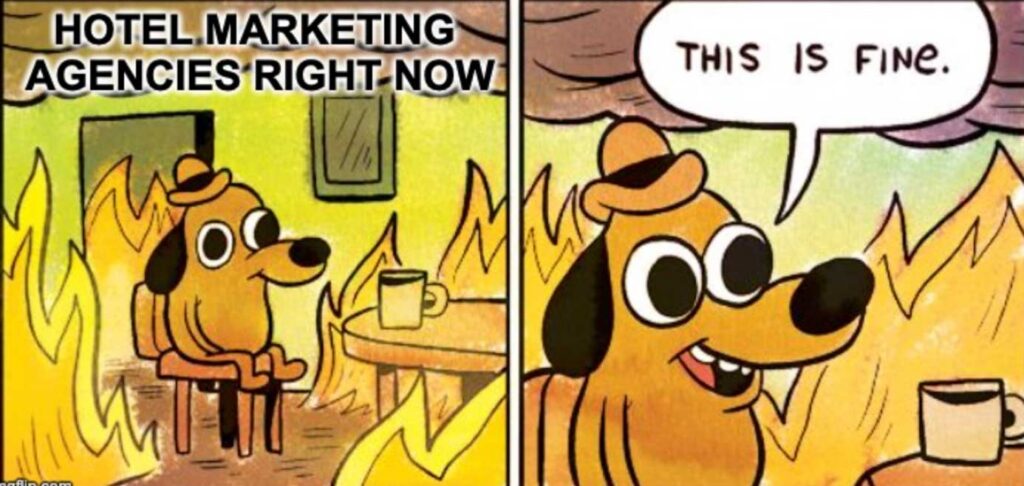

Since the 1970s, hotels have been accumulating software acronyms like PMS, CRS, RMS. Each new wave of technology was launched with a sales pitch and the sincere conviction that it was going to fix everything and generate more profits. Now that AI has joined the alphabet soup, software vendors are slapping those two letters onto everything that runs on electricity, including products built back in 1995. This is such a big trend right now that the A and I keys on their marketing department’s keyboards are coming loose.
Anyone who has worked in the business knows that hotels are notoriously slow to adopt change. Hotels buy software the way people get tattoos – mostly for life. Private equity and venture capital have taken note of this stickiness, and its accompanying recurring revenue, and have flooded the hotel technology market over the last few decades. Hotel software startup valuations today have reached altitudes that require oxygen. The pressure to sell software before it actually works has never been higher.
The effects of this sales frenzy are evident in the operational disasters hotels deal with every day. As I write this, a hotel team is in panic mode. Their key software is glitching, and the vendor’s “AI support” bot has suggested three solutions, none of which apply to the actual problem the hotel needs to solve.
What really happens once hotel software companies make the sale and move on, leaving the hotels holding the bag? The old school message “your call is important to us” is now a chatbot sending you ten article links instead of solving your urgent issue. How did we get here? Here are some thoughts.
The Software Hustlers
Most hotel software companies start with the best of intentions. Smart people want to make things better and solve problems. However, there are always a few shady ones looking to make quick money and cash out. The shady guys typically fall into two categories.
The Harold Hills
As in the Music Man, they are solving a problem that hotels never had with a solution that doesn’t really exist. You’ll see them touting a “revolutionary platform” that turns out to be a soft clone of existing software in a different color and font, with a well-funded sales team closing deals on a product that is not even finished.
The Travel Missionaries
The second type is more seductive. Their pitch is almost always along the lines of: “I love hotels, I love travel. But the slow check-ins, the systems that don’t talk to each other, the hotel that forgot me after twenty stays, it made me really sad… so I built something better!”
Both of these types build companies that follow the same trajectory. Series A, Series B, and then “in beta” for a period that stretches the meaning of the word. Their sales team grows faster than the engineering team. The support team quietly disappears. And then either a private equity roll-up acquires the whole thing before the product has to prove itself at scale… or the founder pivots to a new “AI-powered journey planner” and is back on a conference stage before your last support ticket gets answered.
Please keep in mind these three important facts:
- Love of travel is not a technical qualification.
- Passion is not an implementation plan.
- A beautiful pitch deck is not a product.
It is great when things take off. It is considerably less great when founders in cool Adidas tracksuits disappear from the face of the earth like Keyser Söze, leaving hotels with a mess to clean up.
900-Pound Gorillas With Bad Customer Service
Right after the 2008 financial collapse, the phrase “too big to fail” entered the zeitgeist, describing institutions so enormous and deeply embedded in the system that their collapse would take everyone else down with them. The size itself became the protection.
Sadly, the hotel technology sector has its own version of this phenomenon. Some companies are so dominant in their category that losing your hotel’s business does not register as a problem worth solving. You are one hotel in a portfolio of thousands. Your support ticket is one of millions. Your frustration is a rounding error.
Here are two recent examples of what happens when your 900-pound software supplier simply does not care anymore.
The Oracle Will See You Now
Unlike the one in the Matrix, the Oracle for hotels won’t take a personal meeting. Oracle Inc’s market cap has swung wildly over the past year, from roughly $560 billion at the end of 2025 down to around $423 billion as of August 2026. Either way, that is a company with an enormous amount of scale and leverage. Opera, their PMS (Property Management System), runs a significant portion of hotel rooms globally. That is a lot of hotels, a lot of guests, and a lot of leverage over every single one of them.
You would think that kind of scale would buy exceptional support. It buys exactly the opposite.
Case in point: My team recently migrated a property to the Opera Cloud PMS. Oracle’s deployment team showed up with the training slide deck for a completely different hotel. (The hotel team who had gathered for the “deployment” kickoff had to tell the deployment manager that the slides were incorrect after the presentation started!) The warning signs were all there. Both the Sales and Project managers had quit in the time since the contract was signed, the new lead was sending rude emails, etc. My emergency backup revenue team ended up working nonstop shifts across several time zones to avert the deployment disaster, as nothing was tested or set up correctly all the way to launch day. It was a surreal experience. The only upside: it made us stronger as a team. Downside: we were not the ones getting an Opera commission.
The real kicker: The hotel had been using Opera since it opened! They were only switching to the cloud version. Another shocker: the historic data was not even part of the migration process. If this is what first-class support looks like from the biggest PMS in the business, imagine what basic economy looks like from smaller providers.
The fact is, when they control a significant portion of the global hotel PMS market, the incentive to delight any individual customer approaches zero. You are captive. They know it. There is a four-month wait to buy and install the software, so hotels have to stay in line with their wallets open. The long line of new hotels behind you keeps the leverage exactly where Oracle needs it. Meanwhile, pay no attention to the support queue behind the billion-dollar curtain.
The Booking Engine That Could
Booking engines (or CRS, Central Reservation Systems) have been a source of angst since hotels first tried to sell rooms on the internet. I have written about this broken cash register problem before.
Sabre acquired SynXis Corporation in late 2004 for $40 million. Then SynXis went on to become the central reservation system for some of the largest hotel brands in the world. I migrated several hotels onto the platform because, genuinely, it was best-in-class: great customer service, painless onboarding, strong revenue performance. I recommended it confidently to clients over the years and migrated many of them onto the platform. I was invited to the 2004 SynXis/Sabre acquisition party, which included a live camel at the hotel rooftop pool in Arizona!
Fast forward to April 2025: Sabre agreed to sell its entire hospitality business to TPG for $1.1 billion in cash, a 27-fold return on that original $40 million. Lovely for Sabre. Less lovely for the hotels that had built their commercial operations around the platform. Also bad for consultants who had recommended the engine to their clients. You can see where this is going.
What followed was not a transition. Rounds of layoffs swept through offices worldwide. The “inflation offset program” that aimed to become “AI-native” translated in practice to replacing experienced support staff with community portals and chatbots. The people who knew your hotel configuration, remembered your quirks, and picked up the phone on a Friday afternoon were gone. Owners and asset managers called me to ask what had happened to the product I had so highly recommended.
The company rebranded with a cool new name. However, the institutional knowledge that held the operation together evaporated, because it lived in people, not in documentation. What replaced them is a ticket number, an AI bot that cannot answer operational questions, a community portal, and a callback window measured in business days.
New Kids on the Block, Same Old Problems
So the old guard is a mess. Surely the shiny new entrants, flush with venture capital and cloud-native architecture, are doing things differently. Right?
Mostly, yes, they are doing things differently. But differently is not the same as better. Remember, kids: when a company raises hundreds of millions of dollars in venture capital, that money comes with strings attached, plenty of them.
A great example in the PMS space is Mews and Cloudbeds, the two most talked-about modern property management systems in the industry. Mews has raised approximately $710 million across nine rounds, most recently a $300 million Series D in January 2026 at a $2.5 billion valuation. Cloudbeds has raised approximately $248 million, with its last disclosed round being a $150 million Series D back in 2021. Both platforms are genuinely more modern than the legacy dinosaurs. The founders seem like good people, and I am sure they diligently follow my blog. Jokes aside, they are building in a difficult space, and they seem to care about hospitality. But caring is not the same as delivering, and here is where the venture capital wardrobe starts to show its seams.
When you raise that kind of money, you are answerable to your investors first. That means the sales team always grows faster than the product team, commission structures reward closing over retaining, and territory expansion happens before the support infrastructure exists to serve the new territory. Product upgrades get rolled out before they are tested, and the person left holding the bag is always the hotel owner who signed the contract.
Here is one small illustration of where the priorities actually sit. Both companies run campaigns built around what’s called “brand conquesting,” which is essentially bidding to intercept each other’s customers before they even finish typing a search. Cloudbeds has a dedicated page titled “Meet the smarter Mews alternative.” Mews fires back with its own page: “The reliable Cloudbeds alternative.” It’s legal, common, and entirely rational from a growth metrics standpoint. It is also a perfectly clear signal about where the money is actually being spent: not on support, not on closing product gaps, but on stealing the other company’s next customer.
Their core focus should be the customer, not new customer acquisition gimmicks. Among my clients and partners on both platforms, the sentiment is consistent: people are not thrilled with the product and want upgrades. Without turning this into a product review, here is a small snippet:
- Mews users report a system that sometimes refuses to let them log in, with no explanation. Basic tasks require too many clicks. The AI support cannot answer operational questions. Phone support requires booking two days in advance, and costs extra.
- Cloudbeds users flag reporting tools that cannot date-range accurately (which human accountants find infuriating). Th reservation engine has outages. Payments are returned to guests without the hotel’s knowledge. Bookings the system confirmed don’t appear at the property. Oh, and support, in the words of multiple reviewers, is “friendly” but accomplishes absolutely nothing.
Both companies have earned awards and have genuine advocates. That is not the point. The point is that hundreds of millions of dollars are being deployed to grow the customer base faster than the product can reliably serve it.
And then, as this article was still in my drafts, Mews handed me a postscript. On July 7, 2026, Mews announced it was cutting 15 percent of its 1,350-person workforce, roughly 200 roles, in its deepest restructuring since the pandemic, just six months after raising that $300 million at a $2.5 billion valuation. They said that AI has made the roles obsolete, jobs built for an era that is ceasing to exist. Customer-facing roles, the company said, were largely unaffected.
That is the official line. Perhaps it is true. But if you have been reading carefully, you will remember what happened at Sabre/SynXis when the same assurances were given. Institutional knowledge does not live in org charts. It lives in people. And roughly 200 of them just left the building.
This, sadly, is the hotel software pattern. And it plays out the same way every time, at every scale, from billion-dollar incumbents to well-funded startups who want you to talk to an AI chatbot when a software disaster hits your hotel at 3pm on a Friday.
The Hotel RMS Black Box
Since I spent time in a senior role inside an RMS (Revenue Management System) company, I got a proper look behind the curtain. I am sorry to report there is no magic to it. Since we have covered PMS and CRS, let’s take a quick peek at the RMS world.
The RMS sales pitch has not changed in years. The only difference is the word “AI” is now added on top of everything and it goes something like:
“Our AI-powered algorithm analyzes a bazillion data points in real time. Competitor rates, local events, historical demand, weather patterns, flight data, micro signals, someone sneezing in the coffee shop three blocks away, a teenager calling something ‘chopped.’ We monitor everything and give you the optimal rate.”
Sounds incredible. The problem is what really happens after you sign and implement. Questioning the output gets subtly positioned as a failure to trust the technology. That RMS “black box” culture is where hotel revenue goes to die.
The hotels winning with an RMS are the ones with revenue management teams who treat the recommendations as a starting point, not a magical final answer. They know what the system cannot see. They also know that an algorithm trained on three years of post-pandemic data is not fully calibrated for what is happening in their market right now. They think, and then override as needed.
The hotels failing today, even with the best-in-class RMS, are the ones who implemented it and then stopped thinking. “The system handles our pricing” is the single sentence I have heard most often right before discovering genuinely terrible revenue performance for a hotel.
One last thing. Calling your RMS “AI-powered” in 2026 is roughly equivalent to calling your microwave a “quantum-assisted thermal optimization device.” Not technically false, but still very annoying. Please stop.
Slapping AI Lipstick on a Pig
The playbook is embarrassingly simple, and right now it is working industry-wide on every type of hotel software you can imagine.
- Take legacy software running on architecture from 2005, or 1995 if the vendor is feeling nostalgic.
- Add a chatbot to the front end. Build a “predictive insights” dashboard nobody asked for.
- Tell the sales team to say “AI-powered” until it loses all meaning.
- Redesign the logo. Issue a press release about your next-generation AI platform.
- Raise prices. Repeat.
Think of it as The Wizard of Oz with a machine learning certificate. Same man, same curtain, same levers. The curtain just has a nicer animation now, and the business cards say “AI-native.”
The remarkable thing is that it sells. It sells because hotel owners are genuinely curious about what AI could do for their business, which is a completely reasonable thing to be curious about. It also sells because most people cannot tell the difference between a large language model doing something genuinely novel and a fifteen-year-old decision tree with a chat bubble glued to the front.
To be fair, there are companies doing interesting AI work in hospitality. For more on where AI is actually creating value in hotel commercial strategy, see my earlier piece, 100 Years of Solitude: AI and Hotel Commercial Optimization.
People > Software
The most powerful technology in any hotel is the right human being using it.
Not the PMS, the RMS, the AI upsell widget, or the contactless kiosk. The person. Full stop. Owners and asset managers who invest in the right humans always outperform the ones chasing the next software launch, regardless of what the market throws at them.
The software industry has spent 50-plus years selling the tool as though the tool is the outcome. It is not. A skilled revenue manager on a mediocre RMS beats an unskilled one on the best system money can buy, every single time. A great front desk team on an old PMS will generate five-star reviews no algorithm can manufacture. A general manager who actually understands commercial strategy will find revenue no software was ever programmed to find.
I have watched hotels run on legacy systems deliver exceptional results because the team knew the product cold and used it brilliantly. I have also watched hotels with beautiful, cloud-native, award-winning platforms underperform because nobody trained the staff, the implementation partner vanished after go-live, and the founder was already on stage announcing version 3.0 of something that never worked properly in version 1.0.
So the next time a vendor calls for a demo, skip the feature conversation. Ask these four questions instead:
- What does support look like twelve months after go-live, not just on the day I sign?
- Can I speak with three customers who are two years in, and ask them specifically about support?
- What happens to my data if your company gets acquired?
- Is my data actually safe, or is your VP of Strategic Accounts also moonlighting for his dad’s hotel management company? (IYKYK.)
Then watch what happens to the energy in the room. If the answers get vague or the enthusiasm cools, the wagon is already pointed toward the edge of town. They want the signature. The next conference is already booked.